
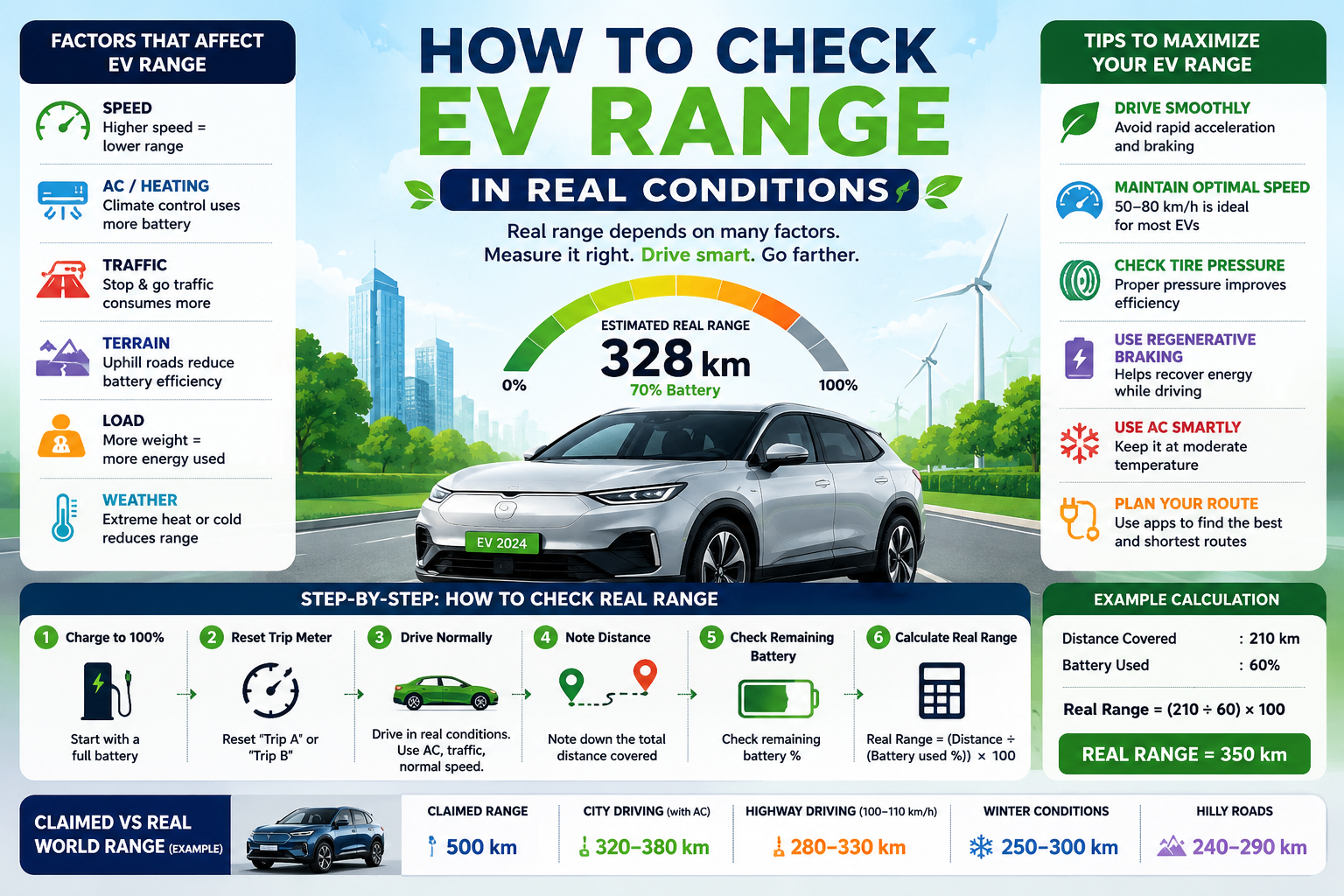

India’s and the world’s EV markets are surging in growth. Now buyers are not just interested in the design and battery size. There is one question that is most important.
How far can this EV travel in real-world usage?
A brand will often condition to promote a range of 400 km, 500 km or even 700 km. The actual range of EVs, however, is often not the same as the stated range. The performance of the battery is influenced by speed, the condition of the roads, driving style, use of air conditioning, and traffic.


For all persons thinking of purchasing an EV or already having one, it is crucial to understand how to test EV range in real conditions. This guide discusses practical methods, actual examples, and smart techniques that enable you to grasp actual EV mileage.
How claimed EV range differs from real range.
The majority of EV companies test their vehicles in a controlled environment. The tests are conducted on smooth roads, at a fixed speed and at the ideal temperatures.
In reality it’s not that way.
- Traffic jams
- Bad roads
- High temperatures
- Heavy braking
- Hills and flyovers
- Full passenger load
- The use of AC and infotainment
You face:
As a result, the performance of the actual EV range can be reduced by 10% to 40%.
For example:
- 430km in urban conditions
- 380 km on highways
- 320 km – full AC and heavy traffic.
The car with a 500 km range can provide the following:
- This difference is an important thing to keep in mind to prevent disappointment
- The first step is to understand how much capacity a battery has
- It is important to know battery capacity before checking the EV range
- The capacity of a battery is measured in kWh
- The higher the kWh, the longer the range
Examples:
| 2023 Nissan Leaf | 400 mile battery range | Claimed 274 miles of range |
| Tata Nexon EV | 40.5 kWh | 465 km |
| MG ZS EV | 50.3 kWh | 461 km |
| Hyundai Ioniq 5 | 72.6 kWh | 631 km |
The larger the battery, the more energy it can store. But efficiency is important as well.
Step 2: Test the energy use.
The energy consumption of EVs is displayed as follows:
Wh/km and km/kWh
The most precise method of estimating the real range.
Formula: Real Range = “Battery Capacity” / “Energy Consumption”.
Example:
- Battery size = 40 kWh
- Consumption = 0.15 kWh/km
Range: 40 ÷ 0.15 = 266 km
This technique yields practical results.
These are just a few of the key factors to consider when trying to estimate real-world EV range.
Method 1: Fully Charge and Drive Normally
This is the easiest and most accurate method.
Fully charge the EV to 100%.
- Reset the trip meter
- Drive normally
- Just use AC as you normally would
Show battery status (when it is below 50%).
Calculate total distance
Example:
- Distance driven = 210 km
- Battery remaining = 30%
- You used 70% battery
Estimated full range:
“Estimated Range” = 210/0.70
Result = 300 km
Use the same procedure in Step 3, but vary the conditions. Repeat Step 3 with different conditions.
The actual range of a real EV varies from situation to situation.
You should test:
- City driving
- Highway driving
- Night driving
- Summer weather
- Rainy season
- Hill roads
Conditions:
- Driving conditions in city areas versus highway areas
- It’s widely believed that highways provide better conditions for mileage
- That is typically not the case for EVs
- The advantages of EVs in urban environments are linked to the regenerative braking, which preserves energy
- Batteries will run down quicker at speeds above 60 kph
Example:
| Cruiser | Average Range: 200 miles |
| City | 420 km |
| Highway | 340 km |
Step 4: Carefully monitor speed
One of the most important factors is speed.
The battery will use up a lot more when travelling at 120 km/h rather than 70 km/h.
Typical Impact
| Speed | Battery Efficiency |
| 50 km/h | Excellent |
| 80 km/h | Good |
| 100 km/h | Moderate |
| 120+ km/h | Poor |
Aggressive driving can cause a loss of 20-30% of the range for many EV owners.
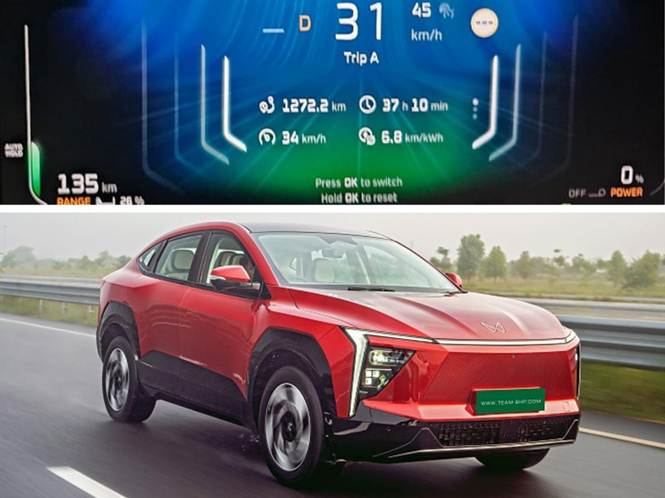
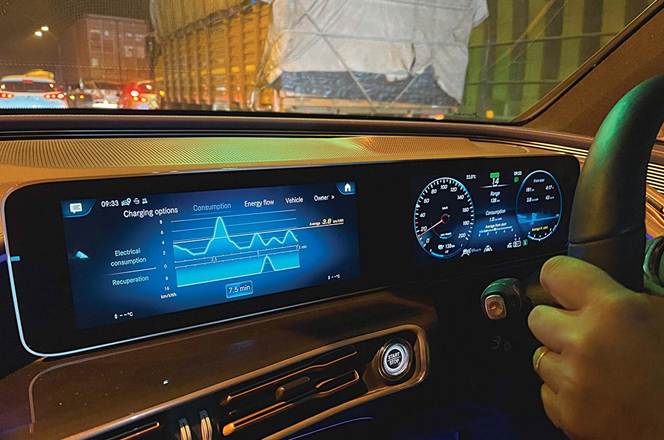
Step 5: Connect to the EV Dashboard Data
Modern EVs give detailed battery info.
Check:
- Remaining range
- Battery percentage
- Average efficiency
- Regenerative braking data
- Real-time power usage.
These tools are used to monitor real-time performance on a daily basis.
Picture Guide: EV Dashboard and Battery Monitoring
Step 6: Weather Impact Understanding
Lithium-ion batteries are highly sensitive to temperature.
In Hot Weather
- AC usage increases
- The battery heats up
The range may be reduced slightly
In Cold Weather
- Battery efficiency falls
The power is used to heat the cabin.
- Range drops significantly
Example
In normal conditions, an EV with a range of 400 km can offer:
- 370 km in summer
- 310 km in winter
Low tyre pressure equals greater rolling resistance.
This decreases the mileage of electric cars.
Maintain recommended PSI levels.
Benefits:
- Better range
- Improved battery efficiency
- Safer driving
The use of just 5-7 PSI less can make a significant difference in EV range.
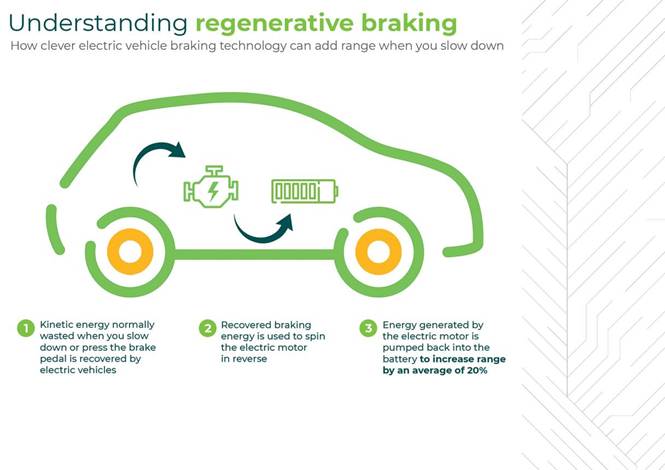
Step 8: Properly use regenerative braking.
Regenerative braking recycles braking energy back to the batteries.
The efficient use increases efficiency.
Best Practices
- Avoid sudden acceleration
- Release accelerator early
- Drive smoothly in traffic
This can boost real-world EV range by 10% or more.
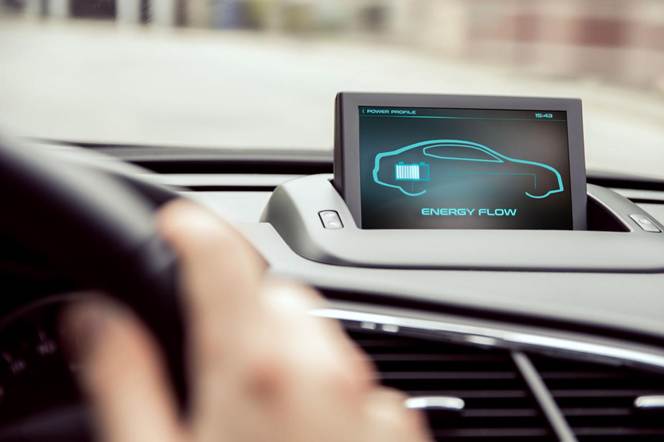
Picture Guide: Regenerative Braking in EVs Picture Guide: Regenerative Braking in EVs
Now, calculate the range once AC is on and once it’s off. Now find the range with AC on and off.
The use of air conditioning has a significant effect on the EV battery life.
Example Test
Without AC: Range = 350 km
With AC: Range = 300 km
Difference = 50 km
That is why summer driving can have a negative impact on EV efficiency.
Verify that a load of passengers and luggage is not obstructing Step 10.
More weight means:
- More power consumption
- Reduced acceleration efficiency
- Lower range
A 5-15% reduction in range with a full EV can be experienced.
This is evident over extended journeys.
The best apps to keep an eye on EV range.
There are a few apps that can calculate real-world EV range.
Popular options include:
- Tata iRA
- MG iSmart
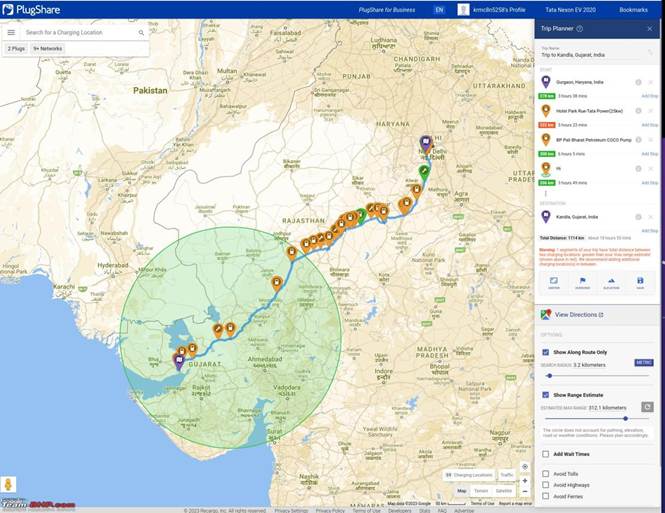
- PlugShare
ABRP, a Better Route Planner.
These apps analyse:
- Driving style
- Route elevation
- Charging stations
- Battery consumption
They enhance trip plans for accuracy.
Here is a real example of EV range testing. This is a real-life example of EV range testing.
Let’s take an example!
Vehicle
Tata Nexon EV
Test Conditions:
- Battery: 100%
- City traffic
- AC ON
- 2 passengers
- Outside temperature: 34°C
Results:
| Parameter Result |
| Distance Driven 245 km |
| Battery Left 18% |
| Estimated Full Range 299 km |
| The company claimed 465km |
Approximately 300 km of real conditions were delivered.
The following is a list of common mistakes that people make when verifying the range of their EV.
1. Blindly believing numbers that have been claimed.
The actual range will always be less.
2. Ignoring Driving Style
Rushing up the acceleration will use up the battery very rapidly.
3. Testing Only Once
Repeat testing at different times under different conditions.
4. Forgetting Terrain Impact
Roads with hills use up more energy.
Increasing EV range in the real world. Real-world tips for enhancing EV range
Drive Smoothly
Avoid sudden acceleration.
Maintain Moderate Speed
70 to 80 km/h is ideal.
Use Eco Mode
The Eco mode restricts power usage.
Do not allow the batteries to be depleted to their lowest levels.
Maintain charge level within 20% to 80% (if possible).
Plan Charging Stops
This helps to alleviate tension while travelling long distances.
The fear of range anxiety is real with EVs!
There is a common worry among new EV drivers – how long will their batteries last?
This is known as range anxiety.
However, India has made great strides in modernising its EV charging infrastructure.
Cities and highways are increasing the number of fast chargers.
Improved battery technology helps to make it more reliable, as well.
Future of EV Range Technology
The battery innovations of the new generation aim at solving the range issues.
Upcoming technologies include:
- Solid-state batteries
- Faster charging
- Better thermal management
- Lightweight battery packs
The potential future EVs could easily be able to reach ranges of over 800 km in reality.
Real World EV Testing Matters Before Purchase!
A lot of people purchase an EV following commercials or YouTube video assessments. However, each driver’s usage patterns are unique. Some have to travel throughout the city, and others are on the highway for long periods of time. This is why personal EV range testing becomes important.
If planning to buy an electric vehicle with better conditions, go on a test drive of 20-30 km and see how the battery percentage decreases. For instance, it’s estimated that the battery range in mixed driving mode could be approximately 300 km, with a drop of 10% after 30 km. This method offers better vision than just taking the company’s word for it.
It would also be wise to enquire from the current owners regarding their experience. The realities of charging speed, battery performance, and seasonal changes in range conditions are often shared by real customers. Other online EV communities and forums can also be useful for understanding real-world electric car mileage.
One of the other key considerations is that of charging station conditions near your home, office, or travel path. A high range is important for an EV, but in an emergency scenario, the inconvenience of poor infrastructure can make a big difference.
With the rapid growth conditions of the EV market in India, customers are shifting their attention to real-world performance and usability over showroom features. Knowing how far EV conditions will actually go in real-world conditions can help you make the best investment and feel more confident driving your EV day to day.
Final Thoughts
You should verify the actual range of EVs first before believing the advertised range. Practical testing provides real-world insights to help you drive smarter and travel more efficiently.
The range is not just based on the size of the battery. Your speed, the weather, the road, your A/C, and your driving techniques are all important.
Track efficiency and test EVs in everyday scenarios from dashboard data. This provides the correct output and eliminates the confusion.
With the advancement of EV technology, the actual driving range of EVs will be more consistent and predictable for all.
FAQs
1. What is the discrepancy between the advertised EV range and the actual EV range?
The guaranteed range is tested under optimum conditions. Actual driving range will vary depending on traffic conditions, weather, driving speed, air conditioning usage and driving style.
2. Can AC shorten the range of your EV?
Yes. Air conditioning draws power from the battery and works to reduce range by 10% to 20%, depending on the temperature and how much air conditioning is used.
3. What are some ways to extend my EV battery range?
Four ways to extend range are to drive smoothly, keep tyres properly inflated, utilise regenerative braking, and avoid high speeds.
4. Does highway driving have a negative impact on EV range?
When EVs are driven on the highway, speed is typically a major factor that decreases their efficiency, as batteries tend to lose power under constant high speeds more than in urban environments.
Learn more: – Tata.ev | Explore Tata Motors’ Range of Electric Vehicles & Drive Green
Related Post: – Which EV SUV is Better for You
2 thoughts on “In Real Conditions 2026: How to Check the Range of a Powerful EV?”