
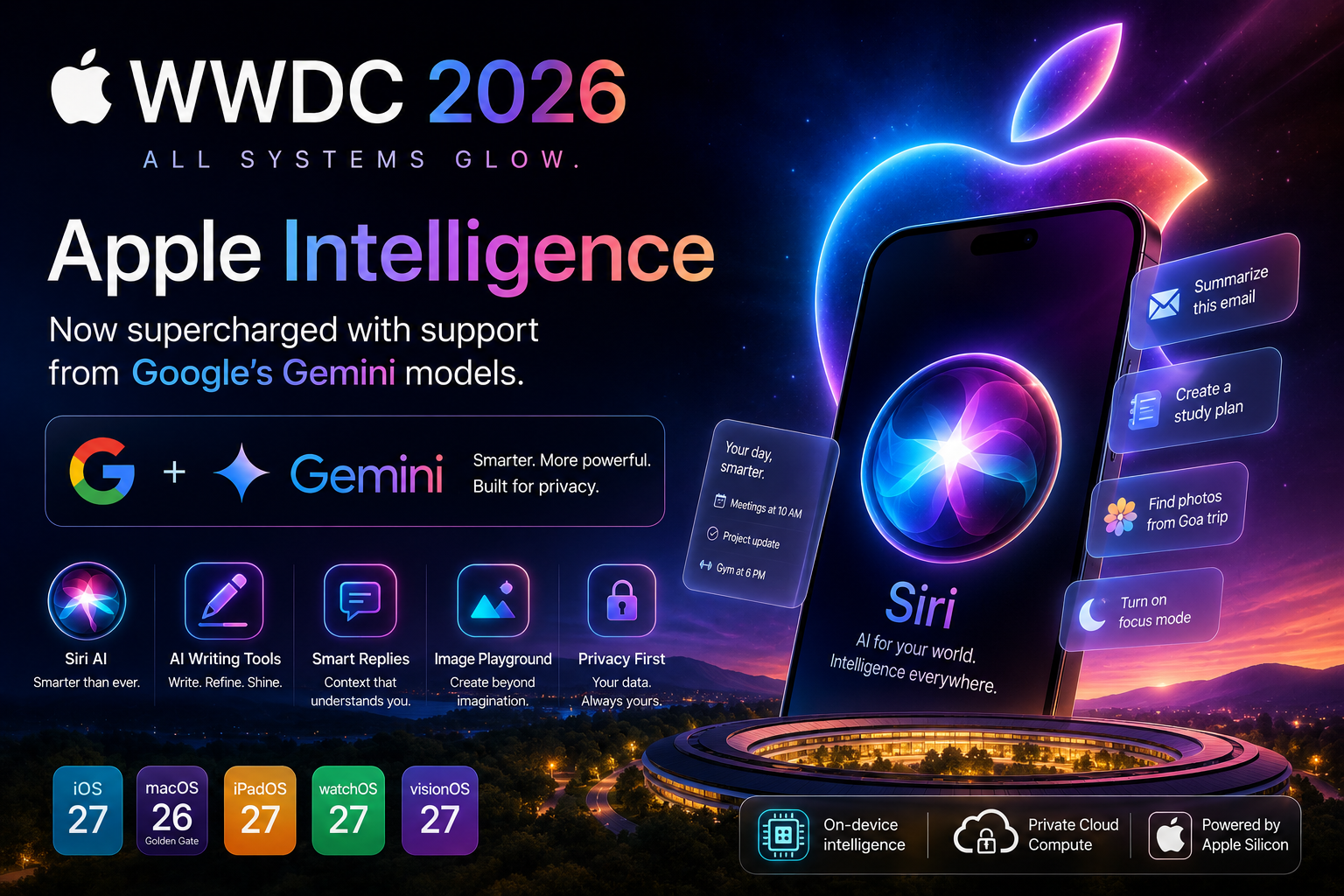

Apple’s Worldwide Developers Conference 2026 became one of the biggest technology events of the year. The company finally revealed the future of Siri, Apple Intelligence, iOS 27, macOS 27 Golden Gate, and a major AI partnership with Google’s Gemini models.
For years, Apple focused on privacy, ecosystem integration, and hardware performance. Meanwhile, companies like Google, OpenAI, and Microsoft pushed aggressively into generative AI. WWDC 2026 showed that Apple is now ready to compete seriously in the AI race.
The biggest headline was simple but powerful. Apple Intelligence now includes support from Google’s Gemini models. This collaboration could completely transform Siri and the entire Apple ecosystem.
This announcement surprised millions of users because Apple traditionally prefers building technology internally. But at WWDC 2026, Apple confirmed that the next generation of Apple Foundation Models was developed in collaboration with Google and Gemini technologies.
The result is a smarter Siri, stronger contextual awareness, advanced writing tools, improved image generation, and a more capable AI experience across iPhone, iPad, Mac, Apple Watch, and Vision Pro.
If you missed the keynote, this detailed guide covers everything important announced at WWDC 2026.
What Is Apple WWDC 2026?
Apple hosts WWDC every year to showcase upcoming software technologies for developers and consumers.
Worldwide Developers Conference focuses mainly on:
• iOS
• macOS
• iPadOS
• watchOS
• visionOS
• AI technologies
• Developer tools
WWDC 2026 became special because Apple moved beyond traditional software updates and entered a new AI era.
According to Apple’s official WWDC 2026 page, the conference highlighted “All systems glow,” signaling the company’s AI-first future.
Apple Intelligence Finally Gets Serious


Apple introduced Apple Intelligence in earlier years, but critics believed the company lagged behind competitors.
WWDC 2026 changed that narrative.
Apple Intelligence now powers:
• Siri AI
• Writing tools
• Smart automation
• Contextual actions
• AI image generation
• Notification summaries
• Smart app suggestions
• Advanced dictation
• Cross-app workflows
The major difference this year is intelligence quality.
Apple openly acknowledged collaboration with Google’s Gemini family of AI models to improve reasoning, contextual understanding, and advanced AI workflows.
This partnership marks one of the biggest strategic changes in Apple’s modern history.
Apple and Google Partnership: Why It Matters
For decades, Apple and Google competed fiercely in software and smartphones.
Now both companies are collaborating in AI.
Reports from WWDC 2026 reveal:
• Apple Foundation Models now use technologies inspired by Gemini
• Siri AI uses enhanced reasoning systems
• Complex cloud AI tasks receive Gemini-assisted processing
• Apple still prioritizes privacy with Private Cloud Compute
According to reports, Apple clarified that user data is protected because requests are processed through Apple-controlled infrastructure rather than directly exposing personal data to Google.
This strategy allows Apple to:
• Catch up quickly in AI
• Maintain user trust
• Improve Siri dramatically
• Avoid depending fully on external AI providers
It is a calculated move.
Apple understands that AI leadership requires both massive infrastructure and cutting-edge models. Google already spent years building Gemini. Instead of starting from zero, Apple partnered strategically.
Siri AI Receives Its Biggest Upgrade Ever


Siri has often been criticized for being less capable than ChatGPT, Gemini, or Alexa.
WWDC 2026 aimed to fix that completely.
Apple introduced “Siri AI,” which is:
• More conversational
• More context-aware
• Better at understanding natural language
• Integrated deeply across apps
• Capable of remembering conversations
• Able to understand screen content
According to multiple reports, Siri AI can now:
• Read what’s on your screen
• Understand emails and messages
• Retrieve information from photos
• Perform cross-app actions
• Handle smarter voice commands
• Assist in productivity workflows
Example:
You can say:
“Send the PDF John shared yesterday to my manager and remind me to follow up tomorrow.”
Siri AI can:
• Find the file
• Understand context
• Identify the sender
• Open Mail
• Create reminder automatically
This level of workflow automation makes Siri far more competitive.
Siri AI Gets a Dedicated App
One unexpected announcement was a standalone Siri AI app.
Apple wants Siri to evolve from a voice assistant into a complete AI companion.
The new app stores:
• Previous conversations
• AI-generated tasks
• Suggestions
• Smart recommendations
• Productivity history
This mirrors how ChatGPT and Gemini operate today.
According to reports, the Siri AI app will work across:
• iPhone
• iPad
• Mac
• Apple Watch
• Vision Pro
iOS 27 Introduces Massive AI Integration


iOS 27 became one of the most AI-focused iPhone updates ever released.
Major features include:
1. AI Writing Tools
Apple upgraded Writing Tools with:
• Proofreading
• Smart rewriting
• Tone adjustment
• Grammar correction
• AI summarization
• Draft generation
These tools work inside:
• Messages
• Mail
• Notes
• Safari
• Third-party apps
Example:
Students can summarize long notes instantly.
Content writers can rewrite paragraphs professionally.
Professionals can improve email tone automatically.
2. Advanced Dictation
Voice typing became dramatically smarter.
Apple claims dictation now understands:
• Punctuation
• Formatting
• Context
• Multi-sentence structure
This can significantly improve productivity for creators and students.
3. Smart Notification Bundles
Apple Intelligence can now:
• Group notifications intelligently
• Detect important alerts
• Reduce clutter
For example:
Instead of receiving 10 camera alerts from smart home devices, Apple Intelligence creates one summarized alert.
4. Smart Safari Features
Safari gains:
• AI webpage summaries
• Auto-monitoring for webpage changes
• AI-generated extension suggestions
• Improved tab management
Example:
You can track ticket availability or product restocks automatically.
Apple Intelligence in Photos and Image Playground


Apple heavily upgraded image AI tools.
New features include:
• AI photo editing
• Object removal
• Scene generation
• Photorealistic image creation
• Smart photo search
• Spatial reframing
Image Playground now supports advanced generative editing.
Example:
You can describe changes naturally:
“Make this image cinematic with sunset lighting.”
Apple Intelligence processes the request automatically.
Photos app improvements include:
• Better face recognition
• Natural language search
• AI memory generation
• Intelligent organization
macOS 27 Golden Gate Gets Smarter
macOS 27 Golden Gate introduces:
• AI integration across desktop apps
• Faster indexing
• Improved performance
• Liquid Glass design refinements
• Enhanced Siri AI workflows
Apple emphasized ecosystem consistency.
Users can start AI tasks on iPhone and continue them on Mac seamlessly.
According to reports, Apple Intelligence now works deeply inside:
• Photos
• Mail
• Safari
• Shortcuts
• Messages
• Home app
Apple’s Privacy Strategy Remains Central
Privacy remained one of Apple’s strongest talking points.
Unlike competitors that rely heavily on cloud processing, Apple continues emphasizing:
• On-device AI
• Secure processing
• Private Cloud Compute
• Limited data sharing
Apple claims:
• Personal data stays protected
• AI tasks process locally when possible
• Cloud requests remain encrypted
This privacy-first strategy could become Apple’s biggest advantage.
Many users want AI features but fear data misuse.
Apple is positioning itself as the “safe AI company.”
What Is Private Cloud Compute?
Private Cloud Compute is Apple’s secure AI infrastructure.
It allows:
• Complex AI processing
• Cloud-based reasoning
• Secure computation
• Privacy protection
Apple says even Apple itself cannot view personal user requests processed through the system.
This is critical because advanced AI models often require cloud resources.
Without cloud support, many modern AI features become impossible.
Apple tries balancing:
• AI power
• Privacy
• Performance
Apple Foundation Models Explained
Apple also introduced updated Apple Foundation Models.
These models power:
• Siri AI
• Writing tools
• Suggestions
• Automation
• Contextual understanding
The architecture reportedly includes:
• AFM Core
• AFM Core Advanced
• AFM Cloud
• AFM Cloud Image
The best AI experience requires newer hardware.
Which iPhones Support the Best AI Features?
Not all devices receive full AI capabilities.
According to reports, advanced Siri AI features work best on:
• iPhone 17 Pro
• iPhone 17 Pro Max
• iPhone Air
These devices include:
• More RAM
• Stronger AI processing
• Better neural engines
Older iPhones still receive Apple Intelligence features, but advanced capabilities remain limited.
This is similar to how Apple handled:
• ProMotion
• Camera upgrades
• Ray tracing
• Spatial video
Premium hardware gets premium features first.
Vision Pro and visionOS 27 Become More Intelligent


Apple Vision Pro also received major AI upgrades.
visionOS 27 introduces:
• Visual intelligence
• AI object understanding
• Enhanced spatial workflows
• Glance-based notifications
• Curved virtual windows
Siri AI can now analyze both:
• Digital environments
• Physical surroundings
This creates futuristic possibilities.
Example:
A user wearing Vision Pro could ask:
“Which book is on that table?”
Siri AI may identify it visually.
Shortcuts App Becomes AI-Powered
The Shortcuts app became dramatically smarter.
Users can now create workflows using natural language.
Example:
“Create a shortcut that sends my daily study notes to Telegram every night.”
Apple Intelligence automatically builds the workflow.
This reduces complexity for ordinary users.
Automation becomes accessible to everyone.
Messages and Mail Receive Contextual Intelligence
Apple Intelligence now understands context across communication apps.
Features include:
• Smart replies
• Reminder suggestions
• Calendar detection
• Meeting extraction
• AI organization
Example:
If someone texts:
“Meeting tomorrow at 4 PM.”
Apple Intelligence can suggest:
• Add to calendar
• Set reminder
• Share location
This creates a more proactive ecosystem.
Apple Intelligence vs Google Gemini
Google and Apple are now both partners and competitors.
Key differences still exist.
Apple Intelligence Strengths
• Privacy-first approach
• Deep hardware integration
• Ecosystem consistency
• On-device processing
Gemini Strengths
• Powerful reasoning
• Advanced multimodal AI
• Faster innovation pace
• Large-scale cloud infrastructure
The partnership benefits both companies.
Apple gains advanced AI capability.
Google gains broader ecosystem reach.
Apple Intelligence vs ChatGPT
OpenAI still leads in conversational AI popularity through ChatGPT.
However, Apple has unique advantages:
• Massive hardware ecosystem
• Native system integration
• Billions of users
• Seamless workflows
ChatGPT remains stronger in:
• Long-form reasoning
• Research assistance
• Coding
• Deep conversation
Apple focuses more on:
• Everyday AI utility
• Productivity
• Smart automation
• Personal assistance
The New Liquid Glass Design
WWDC 2026 also showcased refinements to Apple’s Liquid Glass design language.
Changes include:
• Transparent UI elements
• Cleaner menus
• Better depth effects
• Unified controls
• Smoother animations
Apple aims for:
• Visual consistency
• Simplicity
• Modern aesthetics
AI in Accessibility Features
Apple expanded AI accessibility tools significantly.
Features include:
• AI image descriptions
• Voice assistance
• Accessibility Reader improvements
• Magnifier intelligence
• VoiceOver enhancements
This could help millions of users globally.
Why WWDC 2026 Matters for the Tech Industry
WWDC 2026 signals several major industry trends.
1. AI Partnerships Are the Future
Even giant companies now collaborate.
Apple partnering with Google proves:
• AI development is expensive
• Infrastructure matters
• Speed is critical
2. Privacy Is Becoming a Selling Point
Consumers increasingly care about data security.
Apple uses privacy as competitive differentiation.
3. Smartphones Are Becoming AI Devices
The smartphone industry is shifting from:
• Hardware-focused competition
toward:
• AI-powered experiences
Concerns and Criticism
Not everyone is fully convinced.
Critics raised concerns:
• Apple joined the AI race late
• Some features resemble existing tools
• Hardware limitations restrict many users
• Advanced AI still depends partly on cloud systems
Some analysts also believe Apple risks depending too heavily on Google.
Still, Apple’s ecosystem integration remains unmatched.
Real-Life Use Cases of Apple Intelligence
For Students
• Summarize lecture notes
• Organize assignments
• Generate reminders
• Improve writing
For Content Creators
• Rewrite captions
• Edit photos
• Generate ideas
• Automate workflows
For Professionals
• Smart email drafting
• Meeting organization
• AI productivity tools
• Calendar management
For Families
• Smart home summaries
• Safety alerts
• Better communication tools
Will Apple Intelligence Replace Human Creativity?
No.
AI improves productivity, but human creativity still matters.
Apple Intelligence works best as:
• Assistant
• Organizer
• Productivity enhancer
Not as a complete replacement for human thinking.
Writers still create ideas.
Designers still guide creativity.
Students still need understanding.
AI simply speeds up execution.
Availability and Release Timeline
According to Apple:
• Developer beta is already available
• Public beta arrives next month
• Stable release launches later this year
Initial support focuses mainly on English.
More languages will expand gradually.
Market Impact After WWDC 2026
WWDC 2026 immediately changed market perception.
Investors and analysts viewed Apple’s AI direction more positively because:
• Siri finally improved
• Gemini partnership accelerated capability
• Privacy strategy remained strong
• Ecosystem integration looked impressive
The AI competition now includes:
• Apple
• Google
• Microsoft
• OpenAI
• Meta
• Amazon
The next few years could reshape consumer technology completely.
Get more Information: WWDC 2026 Explained: Siri AI, the Gemini Alliance, and Apple’s $1 Billion AI Bet – INFINITIX | AI-Stack
Final Thoughts
WWDC 2026 may become one of Apple’s most important events in recent history.
The company finally revealed a serious AI roadmap.
The biggest breakthrough was not just smarter Siri.
It was Apple accepting collaboration.
By integrating Google Gemini technologies into Apple Intelligence, Apple accelerated its AI future dramatically.
The result is:
• Smarter Siri
• Better productivity
• More contextual intelligence
• Advanced writing tools
• Improved automation
• Stronger ecosystem integration
Apple still emphasizes:
• Privacy
• On-device processing
• Secure cloud infrastructure
This combination could help Apple stand apart in the crowded AI market.
The AI race is no longer about who launches features first.
It is about who creates the most useful, secure, and deeply integrated experience.
WWDC 2026 proved Apple wants to win that race.
FAQs
What is the biggest announcement from Apple WWDC 2026?
The biggest announcement was Apple Intelligence gaining support from Google’s Gemini AI technologies, leading to a major Siri AI upgrade and smarter ecosystem-wide AI features.
Is Siri now powered by Google Gemini?
Apple stated that its next-generation Apple Foundation Models were developed in collaboration with Google and Gemini technologies. However, Apple still controls the overall Apple Intelligence infrastructure and privacy systems.
Which devices support the new Apple Intelligence features?
Most recent Apple devices receive Apple Intelligence features, but advanced AI capabilities work best on newer models like iPhone 17 Pro and iPhone 17 Pro Max.
Does Apple Intelligence protect user privacy?
Yes. Apple says it prioritizes privacy using on-device AI processing and Private Cloud Compute infrastructure to keep user data secure.
Related Image: Powerful IOS 27 Upgrades iPhone 18